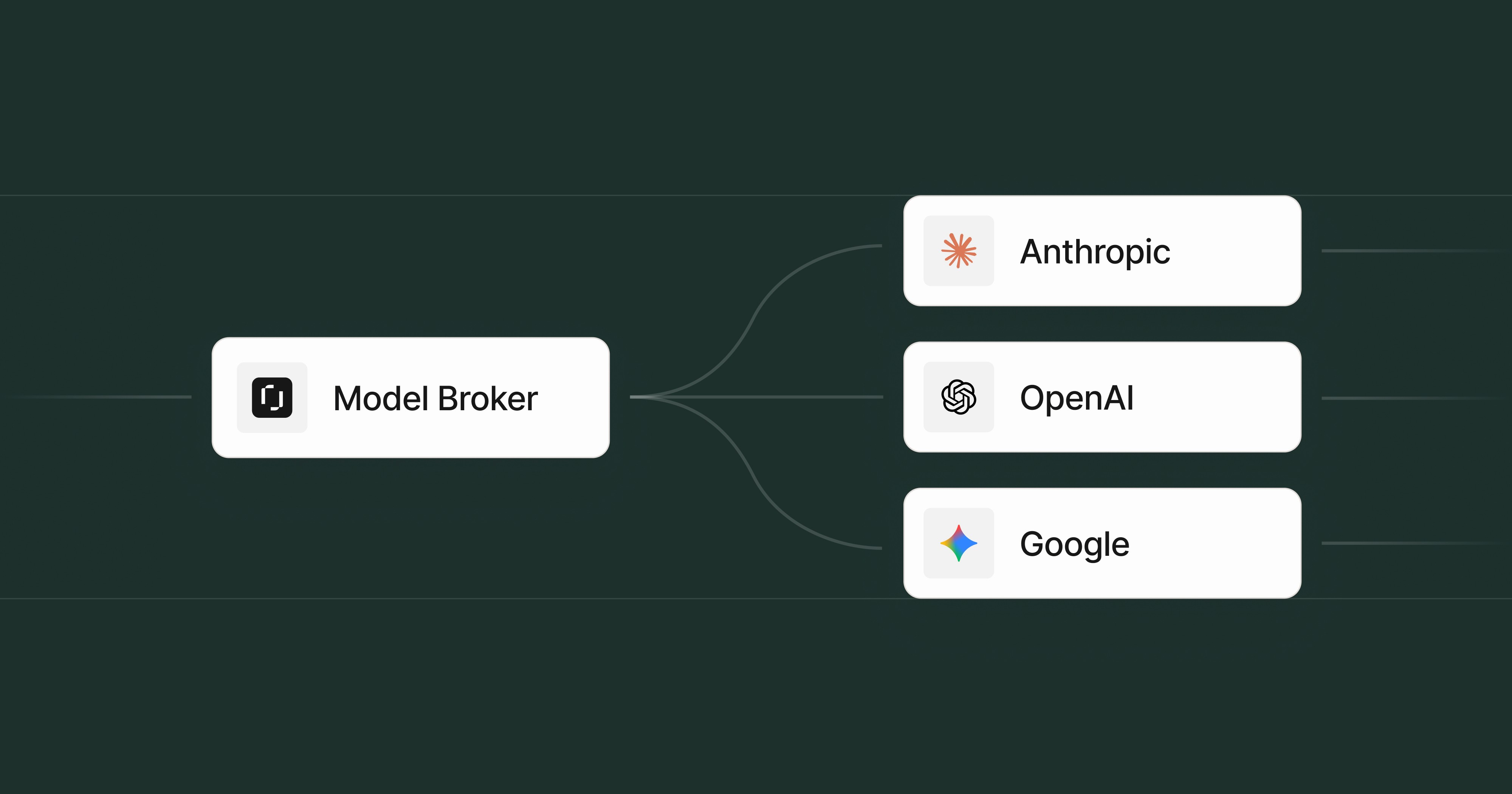
Frontier intelligence where it matters. Economic intelligence everywhere else.
Why we built a model broker
The first generation of enterprise AI optimized for model capability. The next generation will optimize for capability allocation.
Across financial institutions, AI spending is rising rapidly. Yet increasing token consumption does not necessarily translate into greater productivity. In many cases, it reflects inefficiency: 70% of enterprise queries should use a lightweight, cheaper model, but don't.
Most deployments route every request through the same model stack. An email draft, a company profile, and a complex fairness opinion may all receive the same level of intelligence. The result is consistently strong performance, but at a cost structure that is difficult to justify at enterprise scale.
Model Broker is built on a different premise.
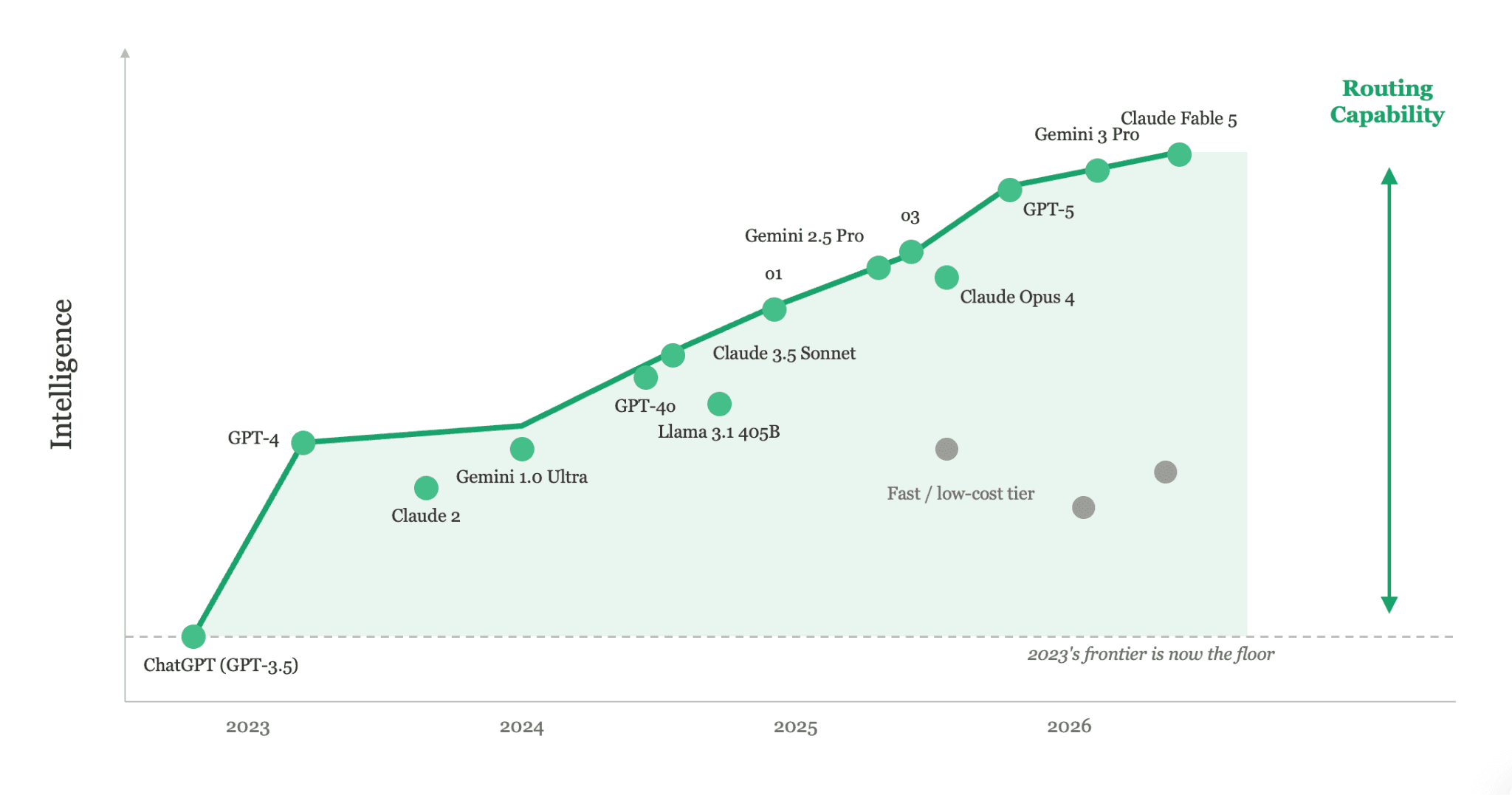
As model capabilities advance, the cost of frontier intelligence rises while the cost of solving many real-world tasks falls. This creates a routing opportunity: instead of applying the most expensive model to every problem, Rogo matches tasks to the models best suited for them. The result is comparable outcomes at dramatically lower costs.
How the token routing improves outcomes for our customers
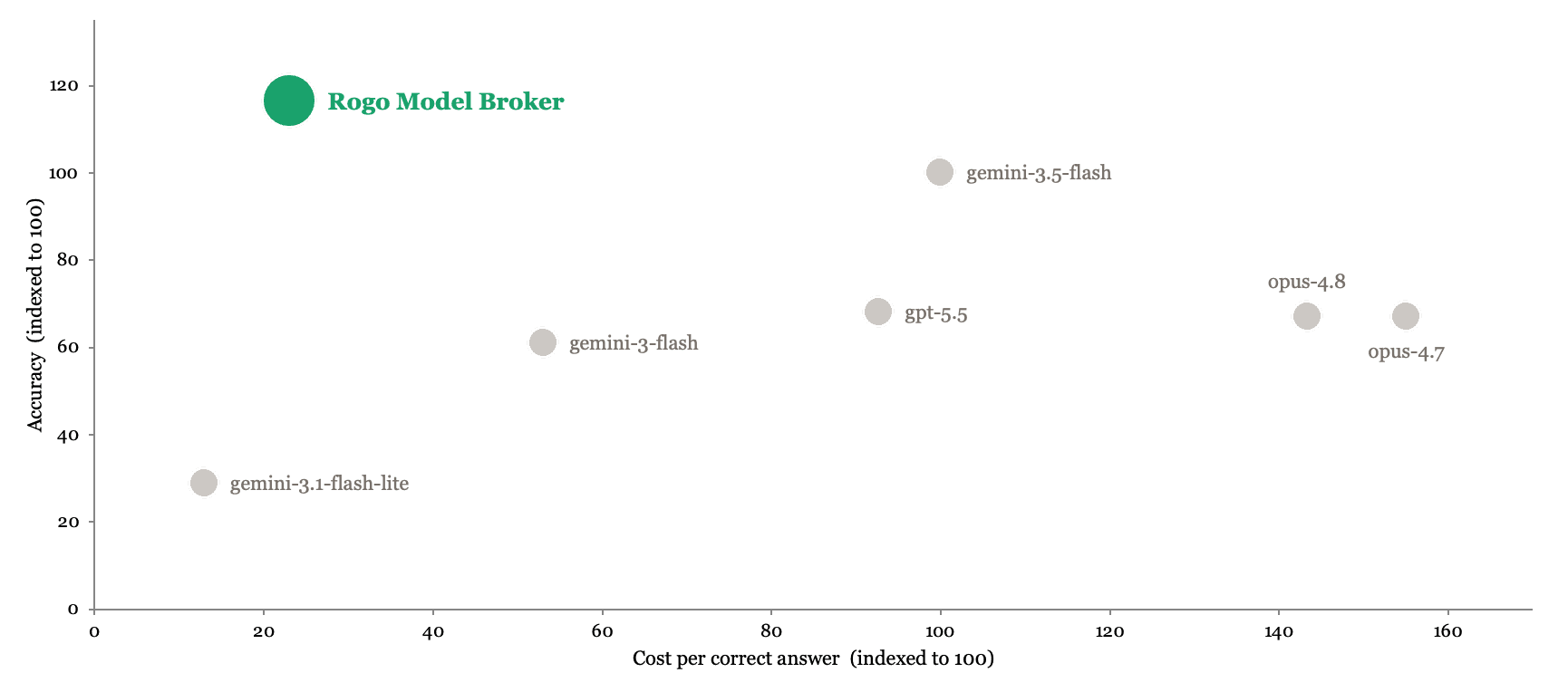
Model Broker improves cost per outcome in two ways.
The first is routing. Our Big Finance Bench evaluation, consisting of 928 questions authored and graded by finance professionals, showed that there is no single best model for finance. Different models perform best on different types of work, while the difference in cost between them can be substantial. The same task can cost roughly $1.26 on a frontier model and $0.02 on a lower-cost alternative. Many financial workflows do not require the most advanced model available, just as a company profile does not require the same level of expertise as a complex M&A analysis. Model Broker continuously evaluates model performance across financial workflows and selects the model that delivers the best balance of quality, speed, and cost for the task at hand.
The second is a purpose-built agent harness. Much of the cost of AI comes not from generating the final answer, but from the reasoning required to get there. Rogo reduces that cost in two ways. First, our pre-configured finance skills and agents encode workflows that models would otherwise have to discover for themselves, reducing redundant reasoning and unnecessary token consumption. Second, our integrations go beyond out-of-the-box MCP connections, retrieving and structuring information in a way that minimizes the work models need to perform. Rather than starting from first principles and sifting through raw data each time, models begin with a structured workflow and context optimized for financial analysis. The result is the same outcome with less computation, making answers faster, more reliable, and less expensive to generate.
Our Model Broker also ensures resilience. Because it operates across model providers rather than relying on a single model ecosystem, work can continue even when individual models experience degradation, outages, or capacity constraints. More importantly, it allows organizations to benefit from the distinct strengths emerging across the AI landscape. Different model providers and model families excel at different tasks, whether that is reasoning, coding, speed, cost efficiency, long-context analysis, or specialized workflows.
The broader point is that AI economics are increasingly determined by cost per outcome rather than cost per token. As models improve, the advantage shifts from having access to the best model to using the right model for the task at hand. The reason is simple: the intelligence required for most financial workflows is becoming widely available, leaving frontier models necessary for a decreasing percentage of tasks. Our Model Broker is built around that principle, continuously adapting as models improve, costs change, and new capabilities emerge.
More posts


